Finally Fit Team
Evidence-based content
Weight Loss with Home Workouts: A 12-Week Program
You don't need a gym to lose weight and shape your body. This 12-week home workout program takes you from beginner to advanced — without expensive equipment.
A gym isn't a prerequisite for successful weight loss. According to research (Suchomel et al., 2018) bodyweight training and simple equipment produce significant results in body composition and muscular strength — especially for beginners. This 12-week program is designed for you if you want to start at home, at your own pace and on your own schedule.
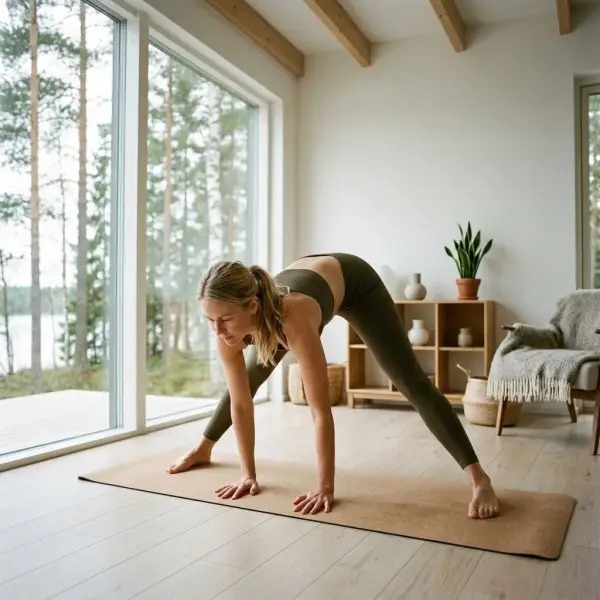
For many people, the threshold to go to a gym is high. Maybe you feel like you don't know enough. Maybe you're worried about other people's stares. Maybe time or money won't stretch to a monthly membership. Maybe you have young children at home and can't get away. Home workouts eliminate all these barriers. All you need is yourself, a small space, and the desire to start. And this program shows you exactly how to do it.
Why do home workouts work for weight loss?
The basic equation of weight loss is a calorie deficit — your body needs to burn more energy than it gets from food. Exercise affects this equation in two ways: it burns energy directly during the workout and raises metabolism long-term through muscle growth.
According to research (Willis et al., 2012) strength training is even more important for weight management than traditional cardio, because it protects muscle mass during a calorie deficit. When your muscle mass is preserved, your metabolism stays active and the risk of the yo-yo effect decreases significantly. Strength training also raises energy expenditure after the workout — the EPOC effect (excess post-exercise oxygen consumption) means your body burns extra energy for up to 24–48 hours after training.
The particular strength of home workouts is their accessibility. When you can work out anytime without commuting, the temptation to skip dramatically decreases. According to research (Ashton et al., 2020) home workout consistency is on average better than gym training — simply because logistical barriers are removed. No need to pack a gym bag, drive to the gym, wait for a free machine, or fit your schedule around opening hours. You can work out in the morning before the kids wake up, during lunch break, or in the evening instead of watching TV.
What do you need?
At minimum, you don't need any equipment — bodyweight training is enough to start. Your own body provides sufficient resistance for the first few weeks. However, a few affordable purchases make training more versatile and enable better progression long-term:
- Resistance bands (3 different strengths): $15–30. Add resistance to squats, glute bridges, and upper body exercises. Start with the lightest and progress to stronger ones as you improve.
- Adjustable dumbbells (5–20 lbs / 2–10 kg): $30–80. Enable progressive overload and more varied training. Adjustable ones are the most space-efficient option.
- Exercise mat: $10–20. Protects knees and back during floor exercises and makes training more comfortable.
- Chair or low bench: Free. Supports step-ups, tricep dips, and elevated push-ups.
In total, you can get started for under $50 — which is the price of one or two months of gym membership. And this equipment lasts for years.
12-week program structure
The program is divided into three four-week phases, where training volume and intensity increase progressively. This follows the principle of progressive overload, which is the foundation of effective training. According to research (Schoenfeld et al., 2017) progressive overload is the single most important factor in muscle growth and strength gains — and it applies equally at home as in a gym.
At the end of each phase, there's one lighter week (deload), where you reduce intensity or volume to give your body time to recover and adapt. This isn't laziness — it's strategic recovery that enables the next phase's intensity increase.
Weeks 1–4: Foundation
Goal: Learn proper exercise technique, build a workout routine, and accustom the body to regular training. At this stage, technique is more important than intensity.
Train 3 times per week, for example Monday, Wednesday, and Friday. Each workout lasts about 25–35 minutes, including a 5-minute warm-up.
Warm-up (5 min): Marching in place 1 min, arm circles 30 s, hip circles 30 s per side, unweighted squats 10 reps, torso rotations 10 reps.
Workout A (full body):
- Squats: 3 x 12 (bodyweight) — Stand slightly wider than hip-width apart. Squat down until thighs are at least parallel to the floor. Keep your back straight and weight on your heels. Rise up in a controlled manner.
- Push-ups against a wall or table: 3 x 10 — If floor push-ups aren't possible, start against a wall and gradually progress to lower surfaces (table, chair, knees, full).
- Glute bridges: 3 x 15 — Lie on your back, feet flat on the floor, lift your hips by squeezing your glutes. Hold the top position for 2 seconds.
- Rows with resistance band: 3 x 12 — Attach the band to a door handle or chair leg. Pull elbows back while squeezing shoulder blades together.
- Plank: 3 x 20 seconds — Keep body straight, hips in a neutral position. Breathe normally.
- Lunges: 2 x 10 per side — Step forward and lower your back knee close to the floor. Keep upper body weight centered.
Workout B (full body):
- Sumo squat: 3 x 12 — Wider stance, toes pointing outward. Targets the inner thighs and glutes more.
- Overhead press (standing, with band or dumbbells): 3 x 10 — Press weights or band ends overhead. Don't let your lower back arch.
- Single-leg deadlift (bodyweight): 3 x 10 per side — Stand on one leg, lean forward while lifting the other leg behind you. An excellent balance exercise.
- Bicep curls with resistance band: 3 x 12 — Stand on the band and curl hands upward. Keep elbows close to your body.
- Side plank: 2 x 15 seconds per side — Supports the lateral core and oblique muscles.
- Calf raises: 3 x 15 — Rise onto your toes and lower in a controlled manner. Do on the edge of a step for greater range of motion.
Alternate workouts A and B on each training day. Rest 60–90 seconds between sets. Log every workout — in a notebook or phone notes.
Weeks 5–8: Development
Goal: Increase training intensity and volume. Start actively using dumbbells for progression.
Train 3–4 times per week. Workout duration about 35–45 minutes.
Workout A (lower body focus):
- Goblet squats with dumbbell: 3 x 12 — Hold one dumbbell at chest height with both hands.
- Romanian deadlift with dumbbells: 3 x 12 — Keep back straight, hinge at the hips and lower weights in front of shins. Feel the stretch in the hamstrings.
- Lunges with dumbbells: 3 x 10 per side — Dumbbells at your sides. A longer step targets the glutes more.
- Glute bridges (feet elevated or weight on hips): 3 x 15 — Elevating feet or adding weight on hips makes the exercise more challenging.
- Calf raises on step edge: 3 x 15 — Greater range of motion than on a flat floor.
- Plank: 3 x 30 seconds — Increase duration compared to the previous phase.
Workout B (upper body focus):
- Push-ups (from knees or full): 3 x 10–12 — Progress from knees to full push-ups as soon as you can.
- Bent-over dumbbell rows: 3 x 12 — Bend to a 45-degree angle, pull weights toward stomach while squeezing back.
- Dumbbell overhead press: 3 x 10 — Press dumbbells from shoulders overhead.
- Chair dips (tricep dips): 3 x 10 — Hands on chair edge, lower body by bending elbows.
- Dumbbell bicep curls: 3 x 12 — Alternating or both arms simultaneously.
- Crunches: 3 x 15 — Lift shoulder blades off the floor while squeezing abs.
Workout C (full body, strength endurance):
- Squat-to-press combo: 3 x 8 — Squat and press dumbbells overhead while rising. An extremely effective full-body exercise.
- Reverse lunges: 3 x 10 per side — A different loading angle than forward lunges.
- Push-up and row combo (renegade row): 3 x 8 — In push-up position on dumbbells, push up then alternate rowing.
- Glute bridge march: 3 x 12 — In the bridge position, alternately lift feet off the ground. Challenges core stability.
- Mountain climbers: 3 x 20 — In push-up position, rapidly alternate driving knees toward chest.
- Plank with arm lift: 3 x 10 per side — In plank position, alternately lift hands off the floor. Requires strong core control.
Want to know where you stand?
A 2-minute quiz reveals your personal barriers and the solution.
Find out your situation →Weeks 9–12: Peak
Goal: Maximize muscle stimulus and metabolic effect. Add intensity techniques and challenge your body in new ways.
Train 4 times per week. Workout duration about 40–50 minutes.
Now add intensity techniques that increase workout effectiveness without additional weight:
- Tempo reps: Slow eccentric (lowering) phase, e.g., 3 seconds down in a squat. Increases mechanical tension and time under tension.
- Supersets: Two exercises back-to-back without rest. Saves time and increases metabolic stress.
- Isometric holds: Hold tension at the most challenging point of the movement for 2–3 seconds.
- Drop sets: Complete a set to failure, reduce resistance and continue immediately. For example, full push-ups to failure, then from knees.
Workout A (lower body strength):
- Dumbbell squats (3 sec down): 4 x 10 — Slow lowering significantly increases the load.
- Romanian deadlift (3 sec down): 4 x 10 — Feel the stretch in hamstrings throughout the entire lowering phase.
- Superset: Lunges + jump squats: 3 x 10 + 8 — Heavy movement combined with explosive movement.
- Glute bridges (3 sec up, 2 sec hold): 4 x 12 — Slow lift and hold at top maximize glute activation.
- Calf raises (2 sec hold at top): 3 x 20 — The hold improves neuromuscular activation.
Workout B (upper body strength):
- Push-ups (3 sec down): 4 x max — Slow lowering makes each rep more challenging.
- Dumbbell rows (2 sec hold at top): 4 x 10 — Squeeze shoulder blades together at the top.
- Superset: Overhead press + lateral raise: 3 x 10 + 12 — Targets different parts of the shoulders.
- Superset: Bicep curls + tricep dips: 3 x 12 + 10 — Complete arm development.
- Crunches with legs elevated: 3 x 15 — A more challenging version of traditional crunches.
Workouts C and D follow the same pattern with different exercises: C combines upper and lower body exercises and D is a strength endurance workout with supersets and short rest periods.
Progressive overload at home — how to advance
The gym's advantage is that weights can be increased in small increments. At home, progression requires a bit more creativity, but it's entirely possible and effective. According to research (Schoenfeld et al., 2017) progressive overload can be achieved in multiple ways — not just by adding weight.
Seven ways to progress at home:
1. Add reps: 3 x 10 becomes 3 x 15 before adding resistance
2. Add sets: 3 sets becomes 4 sets — increases total volume
3. Slow the tempo: A 2-second lowering becomes 4 seconds — increases time under tension
4. Add resistance: Stronger band or heavier dumbbells
5. Harder variation: Knee push-ups become full push-ups, then feet elevated
6. Shorten rest: 90-second rest becomes 60 seconds — increases metabolic stress
7. Add holds: Hold tension at the top of the movement for 2–3 seconds — adds isometric loading
Log every workout. Logging is a simple but powerful tool: you can concretely see how you've progressed and make informed decisions about progression. When you can easily perform an exercise at the upper range, it's time to move to the next level.
Nutrition to support home training
Training without proper nutrition is like cycling with the brakes on. Protein is especially important: aim for 1.6–2.2 g per kilogram of body weight per day to protect and build muscle mass. According to research (Longland et al., 2016) adequate protein combined with strength training can nearly eliminate muscle loss during a calorie deficit.
Practical nutrition tips:
- Eat a protein-rich meal or snack 1–2 hours before training — it provides energy and protects muscle
- After training, consume 25–40 g of protein within 1–2 hours — supports recovery
- Keep your calorie deficit moderate (300–500 kcal) — too large a deficit impairs workout performance and recovery
- Drink enough water: at least 2 liters per day, more on training days
- Carbohydrates are your training fuel — don't cut them too much, especially on training days
The role of cardio — is it needed?
Strength training is the priority, but light cardio supports the overall picture. According to research (Donnelly et al., 2009) walking is an excellent weight loss support: it's a low-intensity activity that burns energy without significantly taxing recovery.
Add 30–60 minutes of brisk walking on rest days. It burns 150–300 kcal and supports both fat burning and mental health. Walking is also active recovery that promotes circulation and reduces muscle tension.
Most common home workout mistakes
Training too light. Many women fear getting bulky and intentionally train light. According to research (Hunter, 2004) women's testosterone levels are so low that massive muscle growth doesn't happen accidentally. Instead, strength training makes the body firmer, more shapely, and metabolically active. The last 2–3 reps should feel challenging — otherwise the stimulus isn't enough for progress.
Repeating the same workout for months. Your body adapts to the stimulus within 4–6 weeks. After that, the same exercises with the same reps no longer produce progress. That's why this program advances in 4-week phases, with each phase more challenging than the last.
Neglecting recovery. Muscles grow during rest, not during training. According to research (Schoenfeld & Contreras, 2014) 48 hours of rest between muscle groups is optimal for beginners. Sleep at least 7–9 hours per night, eat well, and give your body time to recover.
Skipping the warm-up and stretching. Five minutes of warming up before training significantly reduces injury risk and improves performance. Light stretching after training promotes recovery.
Maintaining motivation for 12 weeks
According to research (Lally et al., 2010) forming a new habit takes an average of 66 days — about 9–10 weeks. A 12-week program takes you past this threshold, at which point exercise becomes a natural part of your daily life. Practical tips for maintaining motivation:
- Mark every completed workout on a calendar — a visible streak motivates. Every check mark matters.
- Take photos every 4 weeks — changes you don't see in the mirror show up in photos. Take a photo from the front, side, and back in the same lighting.
- Track your strength progress — when reps and weights increase, progress is happening even if the scale doesn't move.
- Train at the same time every day — routine beats motivation. When workout time is an automatic part of the day, you don't have to make a decision each time.
- Remember why you started — return to your original reason when motivation wavers. Write it down and keep it somewhere visible.
- Reward yourself — not with food, but with enjoyable things: a new workout top, a bath, a movie. Rewards strengthen the positive association with exercise.
This program is proven to work. Thousands of women have achieved significant body composition results with home workouts. You can too. Start today — the first workout is always the most important one. And it doesn't matter if it's short or imperfect. What matters is that you start.
Read also

Last updated:
Disclaimer: This page contains general health and wellness information and does not replace the advice of a doctor, dietitian, or other healthcare professional. Always consult your doctor before making significant changes to your diet or exercise routine, especially if you have underlying health conditions, are on medication, or are pregnant.
Lasting results start here
Find out why weight loss hasn't worked — and how to finally make it stick.
Take the free wellness quiz →