
Finally Fit Team
Evidence-based content
Losing Weight Without Exercise: Is It Possible?
Not everyone can or wants to exercise. Good news: you can lose weight with nutrition alone. Bad news: without exercise, you lose something important.
The question is common and understandable: can you lose weight without exercise? The short answer is yes — weight loss is fundamentally a matter of energy balance, and a calorie deficit can be created through nutrition alone. But the longer answer is more complex and far more important, and it's worth understanding before you decide to leave exercise out of the equation.
According to research (Thomas et al., 2014) nutrition accounts for about 80% of weight loss results in the short term. Exercise alone without dietary changes produces a modest average weight loss of 2–3 kg. This is important to know: you can't out-train a bad diet. An hour of running burns about 400–600 kcal — but you can cancel that out with a single burger meal. But this doesn't mean exercise is meaningless — it's just a different thing than weight loss.
The calorie deficit is what matters — always and in every case
You lose weight when your body burns more energy than it gets from food. This is a fundamental law of thermodynamics, and no diet, supplement, superfood, or detox drink changes it. According to research (Hall & Guo, 2017) all effective weight loss diets — low-carb, low-fat, Mediterranean, vegetarian, paleo, keto — work for exactly the same reason: they create a calorie deficit. What matters isn't what you eat, but how much you eat relative to your expenditure.
Without exercise, the calorie deficit comes entirely from managing food portions. In practice, this means you need to eat slightly less than your body burns at rest and during daily activities. This is entirely possible, but it requires awareness of what and how much you eat — because a sedentary person's energy expenditure is lower and the margin for error is narrower.
Calculate your energy needs without exercise
Your total energy expenditure without exercise consists of three parts:
1. Basal Metabolic Rate (BMR): The energy your body uses just to stay alive — heartbeat, breathing, body temperature, cell renewal. This accounts for about 60–70% of total expenditure.
2. NEAT (non-exercise activity thermogenesis): Daily movement that isn't formal exercise — walking to the store, climbing stairs, housework, fidgeting. According to research (Levine et al., 2005) NEAT can vary between people by up to 2000 kcal per day and is a significant factor in weight management.
3. TEF (thermic effect of food): Energy used to digest and process food. About 10% of total expenditure.
Typically for a sedentary person, total expenditure is BMR x 1.2. Examples for women at different weights:
- 130 lbs (60 kg) woman: BMR about 1350 kcal, TDEE about 1620 kcal
- 155 lbs (70 kg) woman: BMR about 1450 kcal, TDEE about 1740 kcal
- 175 lbs (80 kg) woman: BMR about 1550 kcal, TDEE about 1860 kcal
- 200 lbs (90 kg) woman: BMR about 1650 kcal, TDEE about 1980 kcal
A moderate calorie deficit (300–500 kcal) from these numbers means that, for example, as a 155-lb (70 kg) woman you'd eat about 1240–1440 kcal per day. This is already quite low — and this is where the biggest challenge of losing weight without exercise lies: a sedentary person has less room to eat, and the margin between eating enough and eating too little is narrow.
What happens to your body when you lose weight without exercise?
This is a critical thing everyone should know before deciding to lose weight without exercise. According to research (Cava et al., 2017) weight loss without resistance training leads to significant muscle loss. Typically 25–30% of weight lost is muscle mass, whereas with strength training it can be under 5%.
A concrete example: if you lose 10 kilograms without exercise, you typically lose 2.5–3 kg of muscle and 7–7.5 kg of fat. The same 10 kg loss with strength training would mean about 0.5–1 kg of muscle and 9–9.5 kg of fat. The difference in the end result is enormous.
Why does this matter in practice? Muscle mass is metabolically active tissue. Its loss concretely means:
- Basal metabolic rate drops permanently — your body burns less energy at rest, so you need to eat even less to keep your weight in check
- Your body becomes softer, even though weight drops — without muscle mass, the body doesn't look firm or toned
- The risk of yo-yo effect increases significantly — a lower metabolism makes weight maintenance harder
- Functional capacity and energy decline — daily tasks like climbing stairs or carrying groceries become harder
- Bone health can suffer long-term — loss of muscle mass reduces the load on bones
According to research (Villareal et al., 2017) especially in women over 50, the effects of muscle loss are significant: reduced muscle strength increases fall risk and affects independent daily functioning for years and decades ahead.
How to minimize the risk of muscle loss without traditional exercise?
If exercise is impossible for one reason or another — health limitations, chronic pain conditions, post-surgical recovery, severe obesity, or acute depression — you can minimize muscle loss with these research-based methods:
Want to know where you stand?
A 2-minute quiz reveals your personal barriers and the solution.
Find out your situation →1. Raise your protein high — higher than normal. According to research (Pasiakos et al., 2013) high protein intake (2.0–2.4 g/kg) protects muscle mass significantly better than normal intake, even without exercise. This is higher than the lower end recommended for active people (1.6 g/kg), but without the muscle-preservation signal from training, protein needs to compensate for this gap. Protein is your best ally in this situation.
In practice, for a 155-lb (70 kg) woman this means 140–168 g of protein per day. It requires conscious planning: Greek yogurt, cottage cheese, chicken, fish, eggs, legumes, and potentially a protein supplement at every meal.
2. Keep the calorie deficit moderate — slow but steady. A 300–400 kcal deficit is better than a 700–1000 kcal deficit. The larger the deficit, the more muscle mass the body loses and the more aggressively metabolism adapts. According to research (Garthe et al., 2011) slower weight loss (0.7% of body weight per week) preserves muscle mass significantly better than rapid loss (1.4% per week). For a 155-lb (70 kg) woman, this means a maximum of about 0.5 kg of weight loss per week.
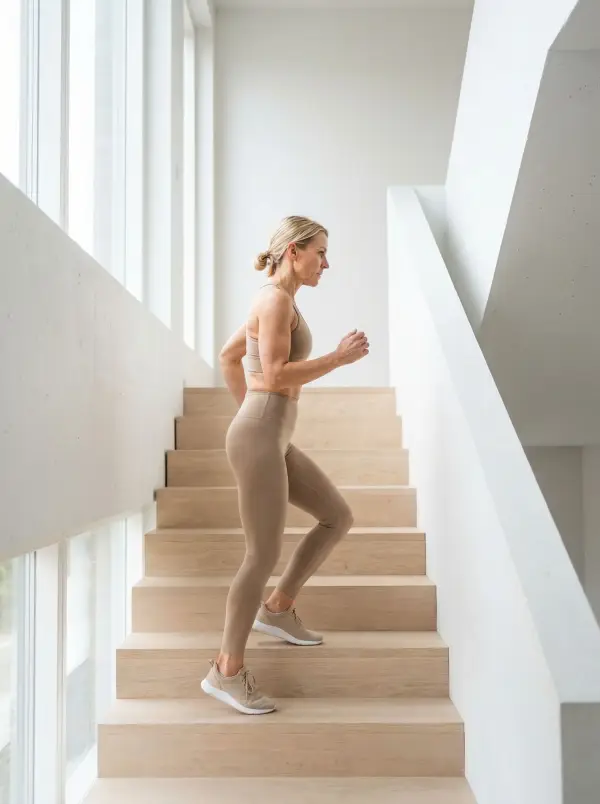
3. Increase daily activity without formal exercise. NEAT activity is an often underestimated factor. According to research (Levine et al., 2005) NEAT differences explain a significant portion of why some people stay slim without formal exercise. Practical ways to increase NEAT without sports:
- Stand more: a standing desk or regular standing breaks (10 min per hour)
- Walk during phone calls — it adds steps without you noticing
- Take the stairs instead of the elevator — every time
- Do housework more actively — vacuuming, mopping, and cleaning burn a surprising amount of energy
- Park farther from the store or workplace
- Get off the bus one or two stops early
- Walk to the store instead of driving, if possible
With these small changes, you can increase daily energy expenditure by 200–500 kcal without formal training.
Nutrition strategies for losing weight without exercise
Since you have fewer calories to work with than an active person, every meal needs to be nutrient-dense — lots of nutrients for few calories. According to research (Rolls, 2009) the energy density of foods is key: foods high in water and fiber (vegetables, fruits, legumes) keep you full on fewer calories.
A practical meal strategy for about 1400–1600 kcal daily intake:
- Breakfast (350–400 kcal): Greek yogurt 250 g with berries and seeds (35 g protein), or scrambled eggs with spinach and whole grain toast (28 g protein).
- Lunch (400–500 kcal): Large salad with plenty of protein (grilled chicken, salmon, or tofu 150 g) and whole grains (quinoa, rice, or pasta). Dressing from olive oil and lemon.
- Snack (100–150 kcal): Cottage cheese 150 g and a piece of fruit, or veggie sticks with hummus dip (2 tbsp).
- Dinner (400–500 kcal): Protein-rich main course (fish 200 g, chicken 150 g, or legumes 200 g) with plenty of steamed or roasted vegetables and moderate whole grain carbohydrates.
- Evening snack (100 kcal): Protein pudding or Greek yogurt.
- Total: about 1350–1650 kcal, 120–150 g protein
Volume eating is an especially useful strategy for losing weight without exercise. The idea is to eat large physical volumes of low-energy-density foods so your stomach fills up and satiety arrives — on fewer calories. According to research (Rolls et al., 2004) eating a salad before the main course reduces total calorie intake by 12% without feelings of dissatisfaction. Examples of volume eating:
- A large bowl of vegetable soup as a starter: 150–200 kcal, but fills the stomach
- A plate of vegetables before the main course: 50–80 kcal
- A whole medium apple: 80 kcal, but requires chewing and takes time — signaling satiety
- A large bowl of watermelon for dessert: 90 kcal, large volume
The importance of sleep and stress is amplified without exercise
When you don't exercise, the importance of sleep and stress management increases even further for several reasons. Exercise itself improves sleep quality and lowers cortisol — when this effect is absent, you need to compensate with other methods.
According to research (Nedeltcheva et al., 2010) sleep deprivation directs the body to burn muscle mass instead of fat — and without exercise's muscle-preservation signal, this effect is even stronger. Sleep 7–9 hours per night — this isn't a recommendation, it's a necessity.
Manage stress actively: chronic stress raises cortisol, which increases hunger and directs fat storage to the waistline. According to research (Epel et al., 2000) the effect of stress on weight is independent of calorie intake — meaning stress can cause weight gain even if you eat the same amount.
When exercise isn't possible — and what are the alternatives?
There are many situations where traditional exercise isn't possible. It's important to be compassionate with yourself in these situations — guilt doesn't help anyone. But it's also important to consider whether some form of light exercise might still be possible:
- Chronic pain conditions: Water exercise is an excellent option — water buoyancy reduces joint stress by 90%. Many people who can't walk can move in water.
- Severe obesity: Walking is usually possible — start with 5–10 minutes. Chair exercises offer an alternative if walking is painful.
- Depression or burnout: According to research (Bray et al., 2016) even 10 minutes of daily walking improves mood and metabolism. Start small — that's enough to begin with.
- Post-surgical recovery: Follow your doctor's instructions and start exercise as soon as it's safe — often that's sooner than you think.
The bottom line: possible, but not optimal
Losing weight without exercise is entirely possible. But it's like driving a car in first gear — you'll get there, but more slowly and less comfortably, and along the way you'll lose more than necessary. The benefits of exercise extend far beyond weight management: mood improves, sleep quality gets better, bones strengthen, heart health improves, brain function sharpens, and overall quality of life rises.
If you can't exercise right now, focus on nutrition and start exercising as soon as it's possible — even in a small form. And if you don't want to exercise, ask yourself honestly: is this about a real barrier or about protecting your comfort zone? Sometimes the very thing we avoid is the thing we need most.
Regardless: you decide your own path, and every step toward healthier habits is valuable — whether it's through nutrition, exercise, or both. The most important change is the one you can sustain permanently.
Read also

Last updated:
Disclaimer: This page contains general health and wellness information and does not replace the advice of a doctor, dietitian, or other healthcare professional. Always consult your doctor before making significant changes to your diet or exercise routine, especially if you have underlying health conditions, are on medication, or are pregnant.
Lasting results start here
Find out why weight loss hasn't worked — and how to finally make it stick.
Take the free wellness quiz →