Finally Fit Team
Evidence-based content
Strength Training for Women: The Complete Beginner's Guide
Strength training won't make you big and bulky — it makes you strong, toned, and metabolically efficient. This is the guide that should have been written years ago.
Strength training for women has rightfully gained popularity in recent years, but myths and misconceptions persist stubbornly. Are you afraid of turning into Arnold Schwarzenegger? Do you think women shouldn't lift heavy weights? Are you unsure whether the gym is your place? Do you feel uncertain about what to do and how? This guide smashes every myth, gives you concrete instructions, and helps you get started — confidently, safely, and effectively.
According to research (Westcott, 2012) strength training improves body composition, raises basal metabolic rate, strengthens bones, improves insulin sensitivity, reduces symptoms of depression, and improves sleep quality. It's not an optional add-on or a trendy hobby — it is an essential part of overall well-being, especially for women whose bone density and muscle mass begin to decline after age 30.
Busting the Myths — Once and for All
Myth 1: Weights make women big and bulky.
This is the most persistent myth, and it prevents millions of women from benefiting from strength training. According to research (Hunter, 2004) women's testosterone levels are approximately 10–20 times lower than men's. Testosterone is the primary hormone driving muscle growth, and without it, massive muscle gain simply doesn't happen — regardless of how heavy the weights you lift. Women who look like competitive bodybuilders typically use anabolic steroids, follow extreme diets, and have trained full-time for decades. It doesn't happen by accident to anyone.
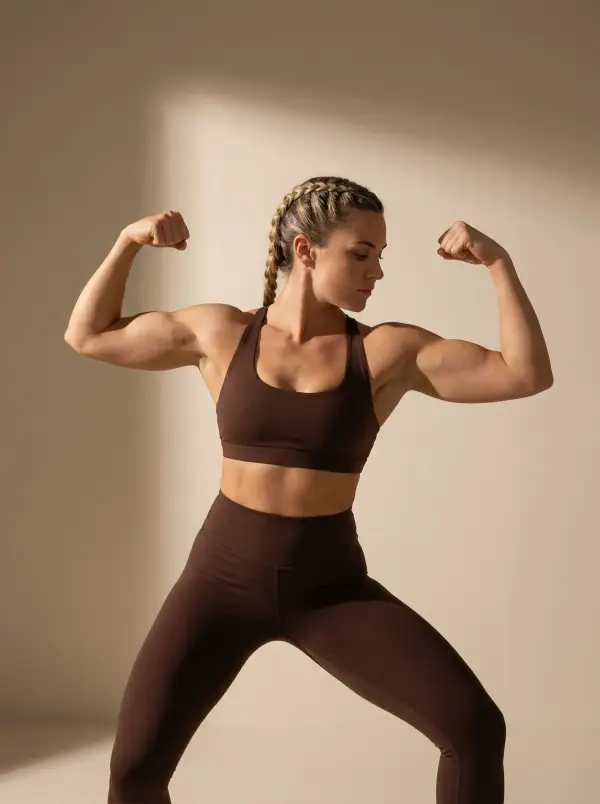
Natural strength training makes a woman firm, beautifully shaped, and strong. The glutes round out, the arms tone up, posture improves, and the waist appears narrower in proportion. The result is athletic and feminine — not massive.
Myth 2: Women need different exercises than men.
Muscle physiology is the same regardless of gender. Muscles contract, grow, and strengthen the same way. The same foundational movements — squat, deadlift, bench press, row, overhead press — are effective for both men and women. According to research (Kraemer & Ratamess, 2004) multi-joint compound movements are the most effective for improving body composition regardless of gender.
The only significant differences are in absolute weight amounts (women typically lift lighter weights because they are physically smaller) and that women should pay particular attention to hip and core stability due to their wider pelvis.
Myth 3: Light weights and high reps create tone.
Tone comes from muscle mass growth and fat reduction — not from the number of reps or sweating. According to research (Schoenfeld et al., 2017) muscle growth occurs best in the 6–30 rep range, as long as sets are taken close enough to failure. The key is mechanical tension — the muscle needs to experience significant load. Light weights that you could do 50 reps with effortlessly aren't enough to stimulate muscle growth. They burn some calories, but they won't change your body composition.
Myth 4: Cardio is for women, weights are for men.
According to research (Willis et al., 2012) strength training produces a better body composition change than cardio alone — especially when the goal is toning and body transformation. Cardio burns calories during the workout, but strength training changes body composition permanently: more muscle, less fat. You can and should do both, but strength training should be the priority.
Benefits of Strength Training for Women — The Research-Backed List
The benefits extend far beyond aesthetics and appearance:
Metabolism and weight management. Muscle mass is metabolically active tissue. Every additional kilogram of muscle raises your basal metabolic rate by approximately 13 kcal per day at rest. This sounds small, but a 5 kg muscle mass gain means approximately 65 kcal per day — roughly 24,000 kcal per year without extra effort. According to research (Willis et al., 2012) strength training raises metabolism even after the workout — the EPOC effect can last up to 48 hours after a heavy training session. Read more about body composition.
Bone health — especially important for women. According to research (Layne & Nelson, 1999) strength training is the single most effective method for preventing osteoporosis. In women, bone density begins to decline after age 30, and after menopause the decline accelerates significantly due to decreasing estrogen. Weight training stimulates osteoblasts (bone-building cells) and maintains bone strength and density for decades.
Mental health and self-esteem. According to a meta-analysis (Gordon et al., 2018) strength training reduces symptoms of depression as effectively as medication — and the effect is independent of training intensity or duration. It improves self-esteem, body image, and quality of life. For many women, the first experience of lifting heavy weights is effective — it transforms the relationship with their own body from weak and vulnerable to strong and capable.
Insulin sensitivity and metabolic health. According to research (Strasser & Schobersberger, 2011) strength training significantly improves insulin sensitivity and glucose metabolism, which reduces the risk of type 2 diabetes and improves everyday energy levels.
Functional capacity and independence. Strong muscles make daily life easier: carrying grocery bags, lifting children, climbing stairs, gardening. With age, muscle strength is directly linked to independent living — and the earlier you start, the better your baseline will be decades from now.
The Beginner's Program: The First 8 Weeks
This program is designed for a woman who has never trained with weights or has been on a long break. It consists of two 4-week phases, and it can be done at a gym or at home with dumbbells. The program focuses on compound movements that load multiple muscle groups simultaneously — the most effective training possible.
Weeks 1–4: Learning the Basics
Train 3 times per week, for example Monday, Wednesday, Friday. Each workout is a full-body session lasting approximately 40–50 minutes including warm-up and stretching.
Warm-up (5–10 min): 5 min walking or light cycling, then mobility exercises: hip circles 10 per direction, shoulder circles 10 per direction, bodyweight squats 10 reps, good mornings (hip hinge) 10 reps.
Workout (full body):
1. Deadlift or Romanian deadlift: 3 x 10 — This is perhaps the single most important movement in the entire program. It strengthens the entire posterior chain: glutes, hamstrings, lower back, upper back, grip. Start with light weight (just the bar or light dumbbells) and focus on technique: back straight, movement comes from the hips, weights close to the body. Ask an experienced lifter or coach for technique guidance — this movement is so important that investing in learning it properly is worth it.
2. Squat (goblet squat with dumbbell): 3 x 12 — Hold one dumbbell at chest height with both hands. Squat down until your thighs are at least parallel to the floor. Knees track over toes, back stays neutral. The goblet squat is excellent for beginners because the weight in front forces the upper body to stay more upright and makes the movement safer.
3. Bench press or push-ups: 3 x 10 — At the gym with a barbell or dumbbells on a bench. At home, push-ups from the knees or full. Strengthens the chest, front of shoulders, and triceps.
4. Row (with dumbbells or cable): 3 x 12 — Strengthens the upper back, rear shoulders, and biceps. An excellent posture improver — especially important for office workers who sit hunched over all day.
5. Overhead press (with dumbbells standing or seated): 3 x 10 — Strengthens shoulders and triceps. Done standing, it also challenges the core.
Want to know where you stand?
A 2-minute quiz reveals your personal barriers and the solution.
Find out your situation →6. Hip thrust: 3 x 15 — The single best glute exercise, according to research (Contreras et al., 2015). Can be done with bodyweight, a dumbbell, or a barbell across the hips.
7. Plank: 3 x 30 seconds — Core stability is the foundation of everything else.
Tips for the first weeks:
- Start with light weights — technique first, weights will follow
- The last 2–3 reps should feel challenging, but technique must stay clean throughout
- Rest 60–90 seconds between sets — this is part of the workout, not laziness
- Log your weights and reps every session — this is how you see progress concretely
- Don't compare yourself to others at the gym — everyone started somewhere
Weeks 5–8: Progression and Split
Now we move to splitting workouts into upper and lower body sessions, which allows greater volume per muscle group and more effective development.
Workout A (lower body, 45–55 min):
1. Squat (back squat or goblet): 4 x 10 — Add sets and weight compared to the previous phase.
2. Romanian deadlift: 3 x 12 — Focus on the stretch feeling in the back of the hamstrings.
3. Walking lunges with dumbbells: 3 x 10 per side — A unilateral movement that corrects imbalances and challenges balance.
4. Hip thrust with weight: 4 x 12 — Add weight across the hips (dumbbell, plate, or barbell).
5. Calf raises: 3 x 15 — Calves are an often-neglected muscle group.
6. Crunches: 3 x 15
Workout B (upper body, 45–55 min):
1. Dumbbell bench press: 4 x 8 — Dumbbells allow a greater range of motion than a barbell.
2. Single-arm dumbbell row (supported on bench): 4 x 10 — Corrects imbalances.
3. Dumbbell overhead press: 3 x 10
4. Lat pulldown or assisted pull-ups: 3 x 10 — Builds a V-shaped upper back.
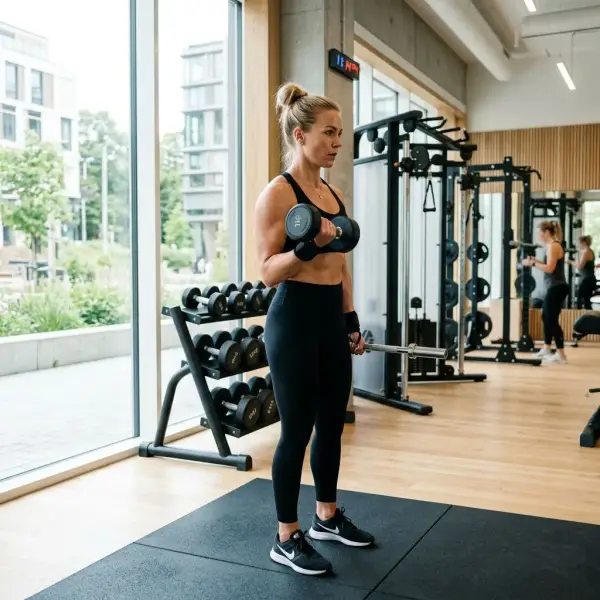
5. Bicep curls: 2 x 12 — Arm aesthetics and functional strength.
6. Tricep dips (off bench edge or cable pushdown): 2 x 12
7. Face pulls (with resistance band or cable): 3 x 15 — Excellent for shoulder health and posture.
Weekly training order: A-B-A (weeks 5 and 7), B-A-B (weeks 6 and 8). This way every muscle group gets sufficient training and sufficient rest.
Progressive Overload — The Key to Results
According to research (Schoenfeld et al., 2017) progressive overload is the single most important factor in muscle strength and muscle growth. Without it, your body has no reason to adapt and become stronger. In practice, this means your training should challenge your body slightly more than the previous session — every time.
A simple progression model for beginners:
- When you can complete all sets and reps with clean technique, add 1–2.5 kg next time
- If you can't complete all reps at the new weight, do as many as you can and add reps from session to session
- When you reach the rep target at the new weight, add weight again
- Log every session — this is how you see progress concretely and make informed decisions
As a beginner, progression is fast and motivating. It's common for weights to increase weekly during the first months. Enjoy this phase — it's the most rewarding time in training.
Nutrition to Support Strength Training
Protein is the most important nutrient for strength training — it's the raw material for muscles. Aim for 1.6–2.2 g per kilogram of body weight per day. According to research (Morton et al., 2018) this is the optimal range for muscle strength and muscle growth at all training levels.
Practical nutrition tips to support strength training:
- Eat 25–40 g protein 1–2 hours before training — provides building blocks and energy
- Eat 25–40 g protein 1–2 hours after training — supports recovery and muscle growth
- Distribute protein evenly across 4–5 meals throughout the day — according to research (Mamerow et al., 2014) even distribution produces better muscle protein synthesis
- Carbohydrates are training fuel — don't cut them too much, especially on training days
- Adequate fat (0.8–1.2 g/kg) is essential for hormone production — a diet too low in fat disrupts the menstrual cycle
If your goal is to lose weight while starting strength training, maintain a moderate calorie deficit (300–500 kcal). According to research (Longland et al., 2016) beginning trainees can build muscle mass and lose fat simultaneously — especially when protein is high. This is called body recomposition, and it's the beginner's superpower.
Recovery — Often Underestimated but Critical
Muscles don't grow during training — they grow during rest. Training provides the stimulus; rest, sleep, and nutrition enable adaptation. According to research (Schoenfeld & Contreras, 2014) a muscle group needs 48–72 hours of recovery time before the next challenging workout. In practice, 3–4 training days per week is sufficient and optimal for beginners.
Key recovery factors:
- Sleep: 7–9 hours per night is absolutely critical. Growth hormone is released primarily during deep sleep, and without it, muscle growth doesn't happen optimally.
- Nutrition: Adequate protein and total calories — too large a calorie deficit significantly impairs recovery.
- Stress management: High cortisol impairs recovery, inhibits muscle growth, and promotes fat storage.
- Active recovery: Light walking, stretching, or yoga on rest days improves circulation and speeds up recovery.
Read more about recovery and rest.
The Most Common Beginner Mistakes — and How to Avoid Them
Training with weights that are too light. If you can do 15 reps easily with a smile, the weight is too light. The last 2–3 reps should feel challenging — you should feel your muscles working. This doesn't mean pain or technique breakdown — just sufficient load.
Only training certain body parts. Many women only train glutes and abs — neglecting the upper body, back, and front of the legs. A comprehensive program that includes all muscle groups produces a better result — aesthetically too. A strong back makes the waist look narrower. Strong shoulders give the upper body beautiful lines.
Overemphasizing cardio at the expense of strength training. Hours on the treadmill or elliptical is not the best way to change body composition. According to research (Strasser & Schobersberger, 2011) strength training is more effective than cardio for changing body composition. Add at most 2–3 sessions per week of 20–30 minutes of light cardio (walking, cycling) alongside strength training — not instead of it.
Not having a training plan. Wandering around the gym without a plan leads to ineffective training. Use the program above or ask a professional coach to create a personalized program for you. A plan brings focus, efficiency, and motivation.
Comparing your training to others. Don't compare yourself to experienced lifters at the gym. Everyone started from scratch. Absolute weights are meaningless — what matters most is your own progress from week to week. Compete only with yesterday's version of yourself.
Strength training is a gift you give yourself. It makes you stronger — physically and mentally. It transforms your relationship with your body from weak to strong, from passive to active. And strength is never a bad thing — it's always useful, always beautiful, and always liberating. Start today, start light, but start. Read more about exercise and weight loss.
Read also


Last updated:
Disclaimer: This page contains general health and wellness information and does not replace the advice of a doctor, dietitian, or other healthcare professional. Always consult your doctor before making significant changes to your diet or exercise routine, especially if you have underlying health conditions, are on medication, or are pregnant.
Lasting results start here
Find out why weight loss hasn't worked — and how to finally make it stick.
Take the free wellness quiz →