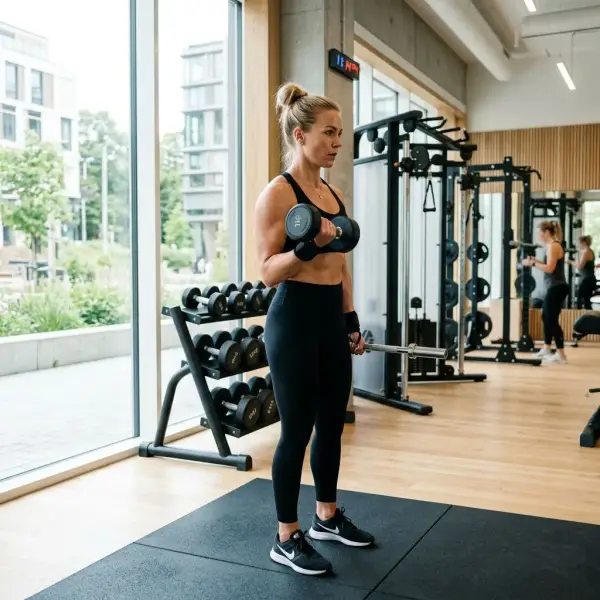
Resistance Training: The Most Important Exercise for Weight Loss
Resistance training – also called strength training or weight training – is the most important form of exercise for long-term weight management, yet it remains underutilized, especially among women. Resistance training preserves and builds muscle mass during weight loss, which keeps metabolism high and prevents the dreaded “skinny fat” outcome. Muscle mass is metabolically active tissue that burns calories even at rest. Resistance training also improves insulin sensitivity, strengthens bones, improves posture, and enhances daily functional capacity. Studies show that the combination of resistance training with a calorie deficit and sufficient protein produces significantly better body composition results than calorie restriction alone. You don’t need a gym membership to start – bodyweight exercises at home are an excellent beginning. Progressive overload – gradually increasing resistance or difficulty – is the key principle for continued improvement. Training 2–3 times per week focusing on major muscle groups is sufficient for most people. Common myths like “weights make women bulky” are not supported by evidence – women lack the testosterone levels needed for significant muscle hypertrophy.
Lasting results start here
Find out why weight loss hasn't worked — and how to finally make it stick.
Take the free wellness quiz →Key Facts
- ✓Resistance training is the most effective exercise for preserving muscle during weight loss
- ✓Each kilogram of muscle burns approximately 13 kcal per day at rest
- ✓Women do not bulk up from resistance training due to lower testosterone levels
- ✓Beginners can build muscle and lose fat simultaneously (body recomposition)
- ✓Training 2–3 times per week is sufficient for most people
Why resistance training is essential for weight loss
During a calorie deficit, the body draws energy from both fat and muscle stores. Without resistance training, a significant portion of weight loss comes from muscle – up to 25–50% in some studies. This muscle loss lowers basal metabolic rate, creates a “skinny fat” appearance, and increases the likelihood of weight regain. Resistance training sends a powerful signal to the body: “keep the muscle, burn the fat.” Combined with adequate protein, it preserves muscle mass almost entirely.
Getting started
You don’t need a gym, expensive equipment, or prior experience. Start with bodyweight exercises at home:
- Squats: Stand with feet shoulder-width apart, lower your hips as if sitting in a chair, keep your chest up, and push back up. Start with 3 sets of 10.
- Push-ups: Start from the knees if needed, or against a wall. 3 sets of as many as you can do with good form.
- Lunges: Step forward and lower your back knee toward the floor. 3 sets of 10 per leg.
- Plank: Hold a push-up position (or from forearms) for 20–60 seconds. 3 sets.
- Rows: Use a resistance band or water bottles. 3 sets of 10–15.
As these become easier, add resistance with dumbbells, resistance bands, or gym machines.
Key principles
Progressive overload is the most important training principle. To continue improving, you must gradually increase the challenge – more weight, more repetitions, more sets, or more difficult variations. Without progressive overload, the body adapts and progress stalls.
Compound movements (exercises that work multiple muscle groups) are the most efficient: squats, deadlifts, bench press, rows, and overhead presses. These should form the foundation of your program.
Training frequency: 2–3 sessions per week is optimal for most people. Each major muscle group should be trained at least twice per week for best results.
Recovery: allow 48–72 hours between sessions targeting the same muscle groups. Muscles grow during rest, not during exercise.
Addressing common myths
“Women will get bulky.” This is physiologically very unlikely. Women have about 10–20x less testosterone than men, making significant muscle hypertrophy extremely difficult without years of dedicated training and specific nutrition. What resistance training does for women is create a toned, firm appearance.
“I’m too old to start.” Research clearly shows muscle growth occurs at any age, including 70s and 80s. Starting is never too late.
“Cardio is better for weight loss.” For pure calorie burning during a session, cardio burns more. But resistance training’s benefits – muscle preservation, metabolic rate maintenance, improved body composition – make it far more valuable for long-term weight management.
Nutrition for resistance training
Protein intake of 1.6–2.2 g/kg supports muscle repair and growth. Distribute protein evenly across meals (25–40 g per meal). Post-workout nutrition within 1–2 hours, including protein and carbohydrates, supports recovery. Adequate calories are important – excessively large deficits impair muscle growth and recovery.
Want to know where you stand?
A 2-minute quiz reveals your personal barriers and the solution.
Find out your situation →Frequently Asked Questions
How often should I do resistance training?
2–3 times per week is sufficient for most people. Each major muscle group should be trained at least twice per week. Allow 48–72 hours between sessions targeting the same muscles.
Will weights make me bulky?
Very unlikely, especially for women. Women lack the testosterone for significant muscle growth. Resistance training creates a toned, firm body, not a bulky one.
Can I do resistance training at home?
Absolutely. Bodyweight exercises (squats, push-ups, lunges, planks) are excellent for beginners. Add resistance bands or dumbbells as you progress. Many effective programs require no gym.
What weights should I start with?
Start with a weight you can lift for 10–15 repetitions with good form, where the last 2–3 reps feel challenging. If you can easily do 15+ reps, increase the weight. Good form is always more important than heavy weight.
How soon will I see results from resistance training?
Strength gains are noticeable within 2–4 weeks. Visible body composition changes typically appear after 6–8 weeks of consistent training. Full transformation takes 3–6 months.
Related Topics
Last updated:
Disclaimer: This page contains general health and wellness information and does not replace the advice of a doctor, dietitian, or other healthcare professional. Always consult your doctor before making significant changes to your diet or exercise routine, especially if you have underlying health conditions, are on medication, or are pregnant.
Lasting results start here
Find out why weight loss hasn't worked — and how to finally make it stick.
Take the free wellness quiz →